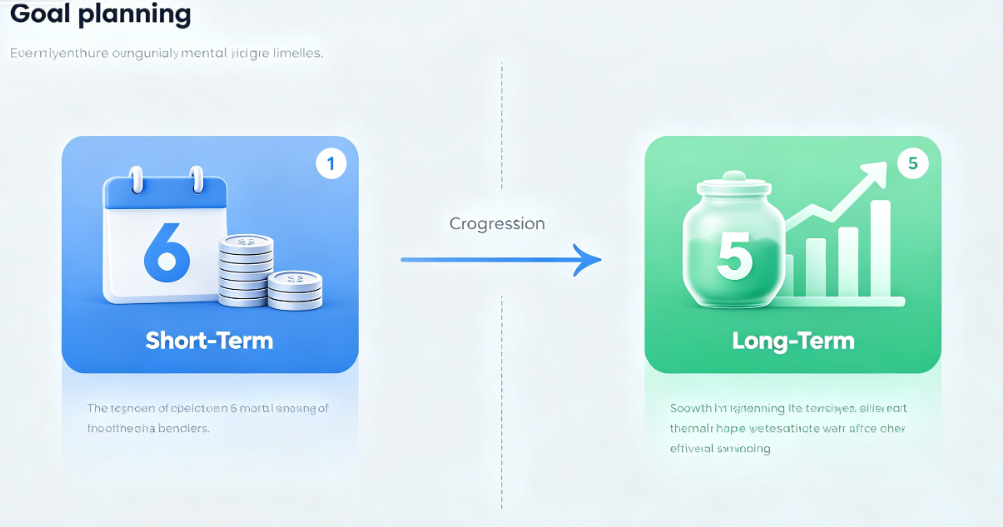
Step 1: Classify Goals by Time Horizon Time Frame Category Examples 0-2 years Short-term Emergency fund, vacation, wedding, car down payment 2-5 years Medium-term Home down payment, fertility/adoption costs, MBA tuition 5-10 years Medium-long Larger home, college (early years) 10+ years Long-term Retirement, college (later years), paying off mortgage early Key principle: The shorter the time frame, the lower your risk tolerance. The longer the time frame, the higher your risk tolerance.
Step 2: Assign the Right “Tool” to Each Goal Time Frame Recommended Tool Expected Return Risk 0-2 years HYSA, money market, short-term Treasuries 4%-5% Very low 2-5 years Treasury ladder, CD ladder, conservative bond fund 3%-5% Low 5-10 years Balanced fund (40%-60% stocks), target-date fund 5%-7% Medium 10+ years Stock index funds (S&P 500, total market) 7%-10% Medium-high Common mistake: Putting short-term money in stocks. “It’s only two years, I’ll be fine.” In 2022, the S&P 500 dropped 19%. If that was your down payment year, you lost 19%.
Another common mistake: Putting long-term money in cash. $10,000 at 0.5% for 30 years becomes $11,600. In the S&P 500 (historical 10%), it becomes $174,000.
Step 3: SMART Goals + Backward Planning A good goal isn’t “I want to buy a home.” It’s:
SMART formula:
Specific: $60,000 down payment
Measurable: Save $1,000/month
Achievable: Income $80,000, can save $1,000/month
Relevant: Aligns with life plan
Time-bound: By March 2028
Backward planning: Start from the target date and work backward.
Example: Need $60,000 by March 2028. Today is April 2026. 23 months remaining.
$60,000 ÷ 23 = need to save $2,609/month.
If your income can’t save that much, you have three choices:
Extend the target date (March 2029 → $1,667/month)
Reduce the target amount ($40,000 down payment → $1,739/month)
Increase income (side hustle, raise, new job)
This is the power of backward planning: it forces reality, not hope.
Step 4: Prioritization and Trade-offs You cannot achieve all goals at once. You must choose.
Priority Matrix:
Urgent Not Urgent Important 1. Emergency fund, high-interest debt 2. Retirement, college Not Important 3. Vacation (if emergency fund not done) 4. Luxury purchases Rules:
Quadrant 1 first (urgent + important)
Then Quadrant 2 (not urgent but important) – this is the key to long-term wealth
Quadrants 3 and 4 only after 1 and 2 are handled
Real-life trade-offs:
If… Then… You can only save $1,000/month Build $10,000 emergency fund first (10 months), then start retirement You want a home but also have credit card debt (22% APR) Pay credit cards first. 22% interest beats any investment return or home appreciation You’re nearing retirement but haven’t saved enough Consider delaying retirement 2-3 years, or lowering expected retirement spending Step 5: Automate – The Only Way Goals Don’t Fail Willpower runs out. Automation doesn’t.
How to set it up:
Short-term goals: Auto-transfer to HYSA on payday
Medium-term goals: Auto-transfer to designated account or target-date fund
Long-term goals: Auto-transfer to 401(k), IRA, taxable brokerage
Example: $5,000 monthly after-tax income
Account Amount Goal Horizon HYSA $1,000 Emergency + vacation Short Brokerage (balanced fund) $500 Home down payment Medium 401(k) $1,500 Retirement Long Roth IRA $500 Retirement Long Checking $1,500 Living expenses N/A Once set up, you make zero decisions. Money flows to your goals automatically.
Step 6: Reassess Annually (and at Major Life Changes) Goals aren’t carved in stone. Life changes.
Annual “financial checkup” (birthday or New Year’s):
Check progress on each goal (on track?)
Update assumptions (rates changed? income changed? market up?)
Adjust amounts or timelines
Celebrate progress made
Life events that trigger reassessment:
Marriage or divorce
Having a child
Job change or major income change
Serious illness or disability
Inheritance
Worksheet: Your Financial Goal Plan (Copy and Use) Goal 1: _____
Time horizon: □Short □Medium □Medium-long □Long
Target date: _____
Target amount: $_____
Need to save monthly: $_____ (amount ÷ months remaining)
Tool: __
Automated? □Yes □No (if No, set it up today)
Goal 2: _____
Time horizon: □Short □Medium □Medium-long □Long
Target date: _____
Target amount: $_____
Need to save monthly: $_____ (amount ÷ months remaining)
Tool: __
Automated? □Yes □No (if No, set it up today)
Goal 3: _____
(same structure)
Monthly savings capacity:
Monthly income: $_____
Monthly expenses: $_____
Monthly savings available: $_____
If monthly savings available < total needed for all goals, you need to:
□ Extend some target dates
□ Reduce some target amounts
□ Increase income (side hustle, overtime, new job)
□ Drop some goals (temporarily)
Conclusion Managing short-term and long-term goals simultaneously isn’t about “balance” – it’s about intentional choice. You can’t have everything. But you can have what matters most to you.
Use the worksheet above. Spend 30 minutes filling it out today. Then set up automation. Then forget it – let the system work.