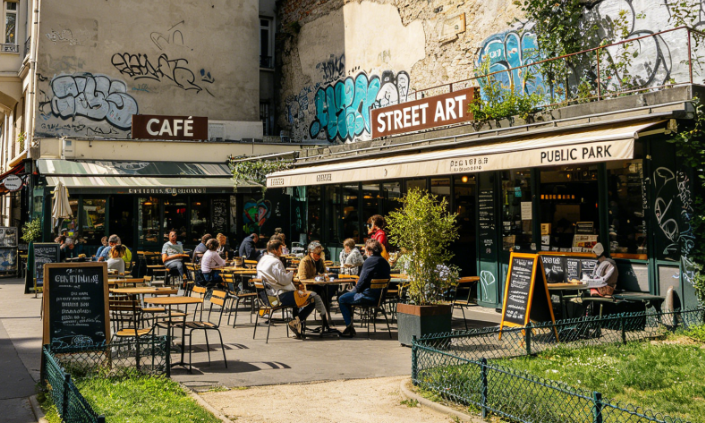
Graffiti writers classify their work by complexity, size, and purpose. Understanding these categories helps viewers appreciate the craft.
Tag – The most basic form: a writer’s signature, usually done in one color (often a marker or spray paint). A good tag has flow, rhythm, and distinctiveness. Writers practice thousands of times to develop a unique handstyle. Tags are the foundation of graffiti culture – they establish a writer’s identity and reputation. Tags can be “get‑up” (frequent tagging) to gain fame.
Throw‑up – Also called “throwie.” A quickly painted bubble or block letter version of a tag, usually two or three colors (e.g., black outline with a silver fill). Throw‑ups are faster than pieces but more visible than tags. They are often used for “bombing” – covering large areas quickly. A classic throw‑up has rounded, overlapping letters.
Piece – Short for “masterpiece.” A large, multi‑color painting that often includes backgrounds, characters, and intricate letterforms. Pieces can take hours or days. They are usually done on legal walls or in abandoned buildings. Writers sign pieces with their crew name and the year. The goal is artistic complexity and beauty.
Wildstyle – An advanced, abstract form of piecing where letters interlock, overlap, and twist. Arrows, connections, and breaks make the letters nearly illegible to outsiders. Wildstyle is about demonstrating technical mastery. It originated in the 1970s Bronx and remains a hallmark of skilled writers.
Blockbuster – Large, simple, blocky letters, often painted with rollers rather than spray cans. Blockbusters cover extensive surfaces (walls, roll‑down gates) quickly. They are less about artistry and more about visibility.
Character – Depictions of people, animals, or cartoon figures. Characters can be standalone or integrated into pieces. The late 1970s saw the rise of characters like Phase 2’s “dancing” figures. KAWS began with graffiti characters before his fine art career.
Stencil – A cut‑out sheet (paper, cardboard) that allows a design to be sprayed repeatedly. Stencils produce sharp, reproducible images. Banksy made stencils famous. Stencils can be detailed but lack the spontaneity of freehand spray.
Sticker (Slap) – A pre‑drawn design on a sticky label, quickly slapped onto surfaces. Stickers allow artists to distribute art widely. Shepard Fairey’s “Andre the Giant” sticker campaign evolved into the OBEY brand.
Heaven – Graffiti painted in dangerous or hard‑to‑reach places (e.g., rooftops, billboards, overpasses). Heaven spots earn high respect for risk.
Ghost / Burner – A piece that has been painted over or faded. Writers sometimes paint “ghost” outlines to hint at lost work.
Each style has its own etiquette. Tagging over another writer’s piece without respect can start feuds. Conversely, “toys” (inexperienced writers) are expected to learn by observing. The language of graffiti is dynamic, constantly evolving with new technologies (digital graffiti, projection bombing). Yet the core remains: leaving your mark in a way that others recognize.