The core concepts of borrowing are not many, but many people do not truly understand them. As a result, they sign documents without knowing what they are signing, and only discover problems when it is time to repay. Understanding these concepts can help you avoid the most common traps.
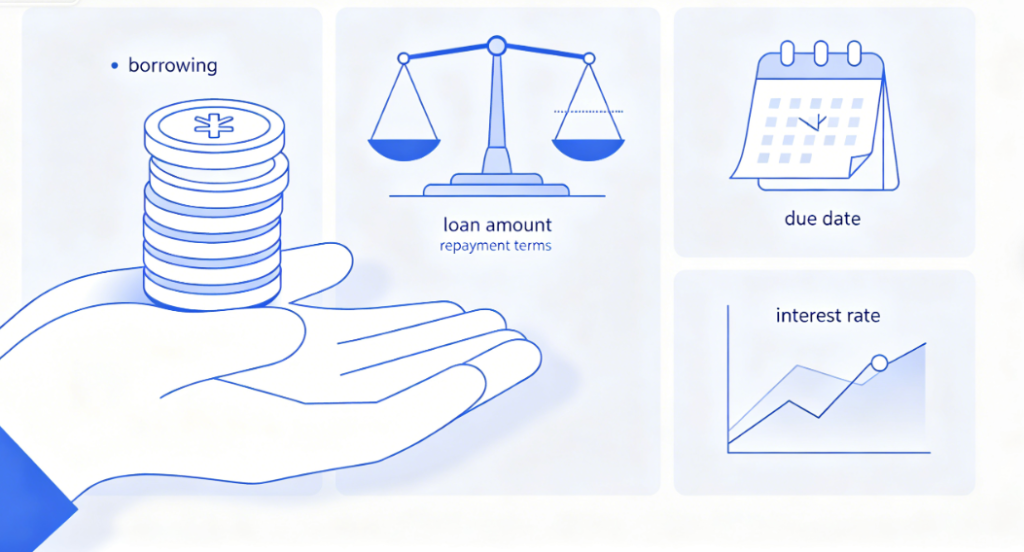
The first concept is the annual percentage rate, or APR. APR is how lenders tell you the cost of borrowing. It includes interest and certain fees, expressed as an annual percentage. Higher APR means borrowing costs you more. Lower APR means borrowing is cheaper. When comparing different loans, do not just look at the interest rate number. Compare the APR. Some loans hide fees outside the interest rate, but APR includes them.
The second concept is the loan term. The loan term is how long you have to pay off the money. Longer terms mean lower monthly payments, but you pay more total interest. Shorter terms mean higher monthly payments, but less total interest. This is a direct trade-off. Many people focus only on the monthly payment, attracted by a low payment, while ignoring that a longer term means much more total interest. A simple rule is to choose the shortest term you can comfortably afford.
The third concept is compound interest. Compound interest means interest earns interest. This is good for savings but bad for debt. If your debt has a high interest rate, like credit cards, compound interest makes your debt grow like a snowball. One thousand dollars you owe today, if unpaid, could become twelve hundred dollars in one year, and over fourteen hundred dollars in two years. This is why high-rate debt needs to be paid off as quickly as possible.
The fourth concept is the credit score. A credit score is a number lenders use to assess your reliability. Higher scores mean you are more likely to be approved and at lower rates. Lower scores mean you may be rejected or only offered very high rates. Credit scores are based on your payment history, amounts owed, length of credit history, types of credit, and recent applications. Building good credit is simple: pay on time, keep utilization low, and do not apply for new credit too often.
Beyond understanding these concepts, you need to ask yourself several questions before borrowing. First question: do I really need this money? Some expenses can be delayed. Some can be paid from savings. Some can be solved in cheaper ways. Borrowing should be a last choice, not the first.
Second question: can I afford the payments? Not just this month’s payment. Every month’s payment until the debt is gone. Consider whether your income is stable. Consider what happens if interest rates rise. Consider what happens if you have an unexpected expense. A good test is to assume your monthly payment increases by twenty percent. Could you still comfortably pay? If not, you are probably borrowing too much.
Third question: what is the total cost? Add up all interest and all fees. That number is the true cost of borrowing. Sometimes this number will surprise you. A seemingly small loan, over several years, can cost nearly half the principal in interest and fees.
Fourth question: is there a cheaper option? Borrowing from family might cost no interest. Using savings might require no borrowing at all. Waiting instead of borrowing might cost nothing. Do not choose the most expensive option just because it is convenient.
There is one more aspect of borrowing that is easily overlooked: its psychological impact. Debt creates stress. Even if you make every payment on time, knowing that you are in debt affects your decisions. You might hesitate to change jobs, start a business, or take risks. This psychological burden has a cost, even though it is not written in any loan contract.
Smart borrowers are not people who never borrow. They are people who understand the costs before borrowing, assess their ability to repay, choose the cheapest option, and have a plan to pay off quickly. Borrowing is a tool. Used well, it helps you achieve your goals. Used poorly, it becomes a burden. The difference is whether you understand these essential facts.