Part 1: Two Withholding Methods When a company pays a bonus, the IRS allows employers to use one of two methods to calculate withholding:
Method 1: Percentage Method (Most Common) For a bonus paid separately (not combined with regular wages), the employer withholds a flat 22% federal rate.
$10,000 bonus × 22% = $2,200 federal withholding
Plus:
Social Security: 6.2% ($620)
Medicare: 1.45% ($145)
State tax: depends on your state (e.g., California 10% = $1,000)
Total withholding: $2,200 + $620 + $145 + $1,000 = $3,965
Take-home: $10,000 – $3,965 = $6,035
This matches what you actually see.
Method 2: Aggregate Method (Bonus with Regular Paycheck) If your bonus is paid on the same check as regular wages, the payroll system assumes this month’s income is your annual income and withholds at an annualized rate.
Example:
Monthly salary: $8,000
Bonus this month: $10,000
Total this month: $18,000
The system calculates: $18,000 × 12 = $216,000 annual income. The federal rate at this income level might be 24%-32%. Withholding will be higher – sometimes over 35%.
This is why people report “bonuses being taxed over 40%.”
Part 2: The Critical Distinction – Withholding vs. Actual Tax Withholding: What’s taken out of each paycheck. This is an estimate. Not your final tax bill.
Actual Tax Liability: The total tax you owe when you file next year. This depends on your total annual income, not any single month’s income.
Key point: If your total withholding exceeds your actual tax liability, you get a refund. If withholding is less, you owe more.
For bonuses: withholding may be too high (because the system “thinks” you get this bonus every month). But when you file, the bonus is combined with regular wages and taxed at your actual marginal rate.
Part 3: Real Example – What Happens at Tax Time Sarah’s situation:
Annual salary: $100,000
Bonus: $10,000 (paid separately, 22% federal withholding)
Total income: $110,000
2026 rates: Single, standard deduction $14,600
Calculation:
Taxable income: $110,000 – $14,600 = $95,400
Federal income tax (2026 brackets): ~$16,000
Withholding:
From salary: based on $100,000, ~$13,000
From bonus: $2,200
Total withholding: $15,200
Result: $15,200 withheld vs. $16,000 actual tax → Sarah owes $800.
Note: Her bonus withholding of 22% was an under-withholding, not an over-withholding. Her marginal rate is 24%, but the bonus was only withheld at 22%.
Part 4: Why People Think Bonuses Are Taxed Higher – Three Reasons Reason 1: The 22% withholding rate looks high compared to your “average” rate
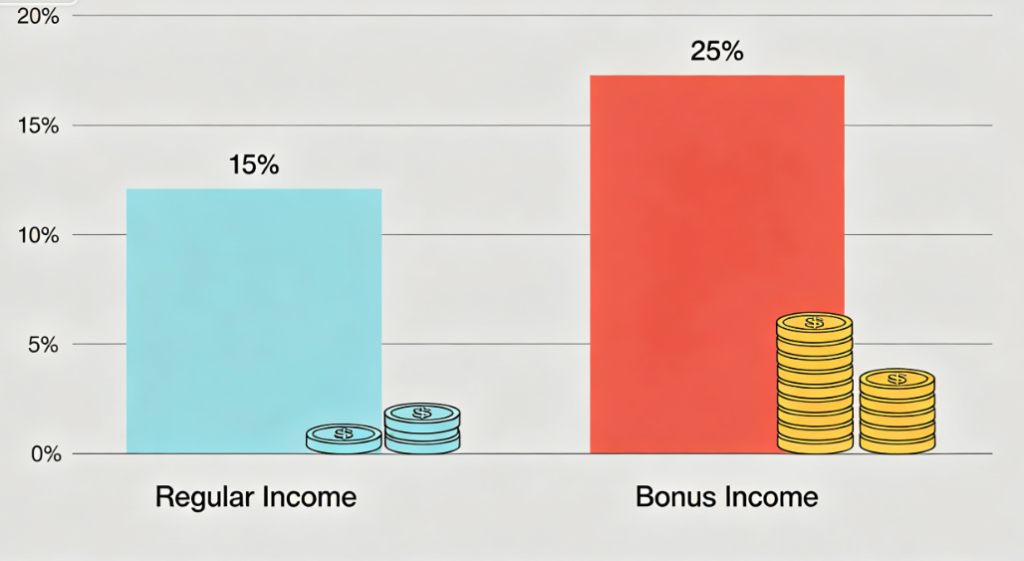
If your average tax rate is 15%, seeing 22% withheld feels high. But your marginal rate (the rate on your last dollar of income) is likely close to 22%. The bonus is that “last dollar.”
Reason 2: Social Security and Medicare taxes aren’t exempt
Bonuses also pay Social Security (6.2%) and Medicare (1.45%). These are flat percentages that don’t phase out at higher incomes. Combined 7.65%, gone immediately at withholding.
Reason 3: State taxes
Some states (California, New York, Oregon) have no cap on bonus withholding. California can withhold 10%+. Federal 22% + state 10% + FICA 7.65% = nearly 40%.
Part 5: Common Questions Q: Can I ask my company to use a different withholding method?
A: For separately paid bonuses, employers typically stick with the 22% percentage method. You can adjust your W-4 (increase allowances) to reduce withholding on regular wages, offsetting the high bonus withholding. But this requires precise calculation – get it wrong and you could owe a large amount at filing.
Q: Is my bonus taxed twice?
A: No. Your bonus, like all your income, is taxed once. Withholding is just “paying early.”
Q: Why was my bonus withheld at over 40%?
A: Likely the aggregate method (bonus with regular paycheck) plus high state taxes. Federal 22% + Social Security 6.2% + Medicare 1.45% + state 10% + possible local tax = 40%+. At tax time, if you over-withheld, you’ll get a refund.
Q: Should I ask for extra withholding to avoid owing at tax time?
A: Yes, if you regularly receive large bonuses that aren’t sufficiently withheld. File a new W-4 and enter an amount on line 4(c) (extra withholding). Example: $200 extra per month.
Part 6: How to Avoid Surprises Next April Step 1: Estimate your total annual income
Include: salary + expected bonus + investment income + other
Step 2: Estimate your total federal tax
Use the IRS Withholding Estimator (free online tool)
Step 3: Estimate your total withholding
Add your annual salary withholding + expected bonus withholding
Step 4: Calculate the difference
If withholding < actual tax → you will owe. If the difference exceeds $1,000, you may need to pay estimated taxes or face a penalty.
If withholding > actual tax → you’ll get a refund. Adjust your W-4 downward if you want less withholding.
Step 5: If you’ll owe, increase withholding
File a new W-4 and add an extra withholding amount on line 4(c).
Example: Expect to owe $1,200. Six months remaining. Add $200/month extra withholding.
Part 7: You Already Got Your Bonus – Now What? You can’t change what was already withheld. But you can:
Don’t spend the entire bonus. Set aside 15%-20% in a savings account for potential taxes owed next April.
Adjust your W-4 for the remaining months of the year. If your bonus was under-withheld (like Sarah’s example), add extra withholding.
Maximize pre-tax deductions. Increase 401(k) contributions, HSA contributions. These lower your taxable income, reducing any amount owed or increasing your refund.
Conclusion Your bonus isn’t being overtaxed. It’s being over-withheld (sometimes) or under-withheld (other times). Next April, when you file your taxes, everything gets “settled up.”
One-sentence summary: The 22% federal withholding is a flat rate. If your marginal tax rate is below 22%, you’ll get a refund. If your marginal rate is above 22%, you’ll owe. That’s it.