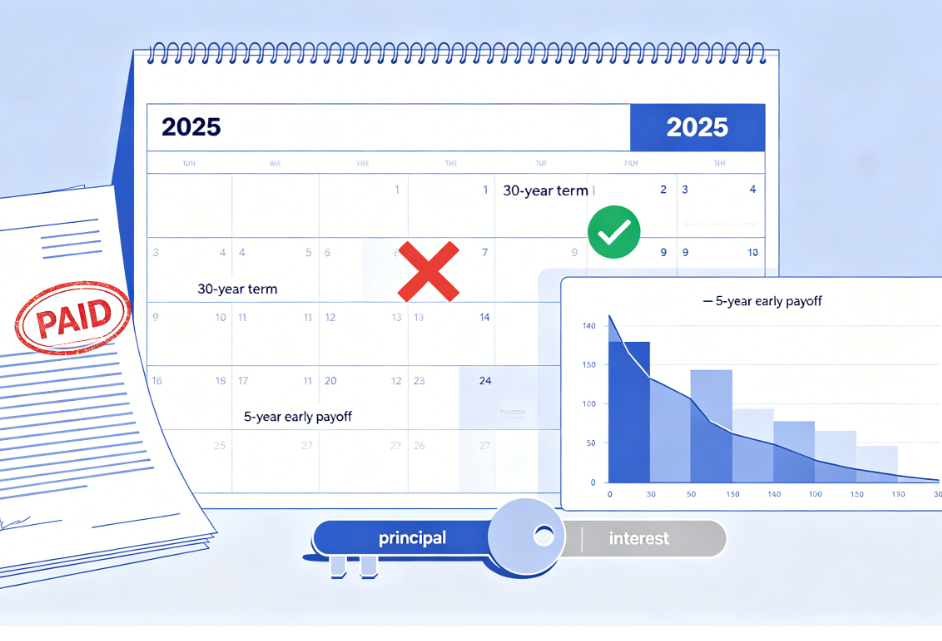
Method 1: Bi-Weekly Payments – The Easiest Accelerator How it works: Split your monthly payment in half and pay every two weeks. With 52 weeks in a year, you make 26 half-payments (13 full payments) instead of 12.
The math:
$300,000 loan, 4.5% interest, 30 years
Monthly payment $1,520
Switch to bi-weekly: $760 every two weeks
Result: Pay off 4.5 years early, save ~$28,000 in interest
How to do it: Contact your loan servicer and ask if they offer free bi-weekly payments. Some companies charge to set this up – don’t pay. Just manually pay half every two weeks.
Method 2: One Extra Monthly Payment Per Year How it works: Same effect as bi-weekly, but more flexible. Make one extra full payment each year, applied entirely to principal.
Practical steps:
Use your tax refund, year-end bonus, or the “third paycheck” months (if you’re paid bi-weekly, two months a year have three paydays)
An extra $2,000 early in the loan can save multiples of that in interest
The math: $300,000 loan at 4.5%, extra $2,000/year → pay off 3.8 years early, save ~$24,000 interest.
Method 3: Mortgage Recasting – The Overlooked Tool How it works: You make a large lump-sum principal payment, and the lender recalculates your monthly payment (lowering it) for the remaining term – OR you keep the same payment and shorten the term.
Comparison:
Recast Refinance Cost $200-$500 $2,000-$6,000 Credit check No Yes Interest rate change No Possible Best for Have cash, don’t want hassle Rates dropped significantly Who should recast: You inherited money, got a large bonus, or sold a car. Pay a $300 fee, and your loan term might drop from 22 years to 15 years.
Method 4: Add $100-$500 Monthly (Same Interest Rate) This is the most straightforward method. The key is making it automatic.
Effect of each extra $100 ($300,000 loan, 4.5%):
Extra monthly Years saved Interest saved $50 2.8 years ~$9,000 $100 4.6 years ~$18,000 $200 7.2 years ~$32,000 $500 11.3 years ~$58,000 How to set it up: Auto-transfer the extra amount from checking to your mortgage on payday. You’ll never “see” the money, so you won’t miss it.
Method 5: The 50% Rule for Windfalls Most people either spend all their windfall (bonus, tax refund, gift, overtime pay) or save all of it. Neither is optimal.
The 50% rule:
50% of windfall → extra mortgage principal
25% → increase savings/investments
25% → reward yourself
Example: $3,000 tax refund
$1,500 extra to mortgage
$750 to emergency fund
$750 for a nice dinner and something you want
This accelerates your mortgage while keeping you from feeling deprived.
Method 6: Lifestyle Downgrade – Apply the Difference This isn’t telling everyone to sleep on the floor. It’s asking one question: On which monthly expense am I getting less happiness than the peace of mind from being mortgage-free?
Common downgrades:
Trade for a cheaper car ($300/month difference → to mortgage)
Cancel an unused gym membership ($80/month → to mortgage)
Pack lunch instead of takeout ($200/month → to mortgage)
Cut one streaming service you rarely watch ($50/month → to mortgage)
Real case: James and Lisa canceled their country club membership ($400/month) and switched to public courses ($60/month). The $340 difference went to their mortgage. Over 8 years, that was $32,640 extra principal – they paid off 5 years early.
Method 7: Refinance to a Shorter Term Prerequisite: Current rates are at least 1% lower than your mortgage rate.
Example:
You owe $250,000 at 5.5% with 25 years remaining
Refinance to a 15-year term at 4.2%
Monthly payment might rise from $1,530 to $1,870
But you pay off in 15 years (not 25), saving ~$85,000 interest
Warning: Only do this if you can comfortably afford the higher payment. Don’t stretch yourself thin just to pay off early.
Hidden cost of refinancing: Closing costs are typically $2,000-$5,000. Run the math: do interest savings exceed costs? You generally need to stay in the new loan for at least 2-3 years to break even.
One Important Trade-off: Pay Down Mortgage vs. Invest Paying extra on your mortgage gives you a risk-free after-tax return equal to your mortgage interest rate.
3% mortgage → paying extra gives a 3% risk-free return
6% mortgage → gives a 6% risk-free return
Money market funds at 5% → if your mortgage is below 5%, the money market is better
Decision framework:
Mortgage rate > 5% → prioritize paying down
Mortgage rate 4%-5% → either, based on risk tolerance
Mortgage rate < 4% → prioritize investing (stocks/bonds), don't pay down early
Checklist: Before You Start Paying Extra I have a 3-6 month emergency fund (don’t put all cash into the house)
I have no high-interest credit card debt (pay off 18%+ cards first)
I’m maxing my 401(k) match (that’s a 100% return)
I understand that extra mortgage payments reduce liquidity (money in the house is hard to get out)
I’ve chosen at least one method from above and set it to automatic
Conclusion Paying off your mortgage early isn’t a right-or-wrong answer. It’s a personal choice. If you hate debt, want a payment-free retirement, or just want the psychological security – one of these 7 methods will work for you. Start small: an extra $50/month. You’ll be surprised by the power of compounding.